
SwissEU™ Dual Qualification
MASTER OF BUSINESS ADMINISTRATION – BY RESEARCH
The SwissEU™ Master of Business Administration – By Research is designed for managers, business professionals, entrepreneurs, consultants and organisational leaders who wish to advance their management expertise through independent research into a relevant business or organisational problem.
Rather than following a conventional coursework-intensive MBA pathway, learners develop an approved research topic, strengthen their research capability and complete a substantial business research project under academic supervision.
The research direction may be aligned with the learner’s professional experience, organisational challenges, industry interests, entrepreneurial activities or intended area of future research.
Upon successful completion, learners receive two master’s-level qualifications:
- Master of Business Administration from EAI Malta
- Master of Business Administration from EIMT Switzerland
Delivered through Swiss Live Class Direct™, the programme combines structured research development, academic supervision, Swiss academic engagement and a nationally recognised European master’s qualification.

DUAL QUALIFICATIONS
- Master of Business Administration awarded by EuroAmerican Institute, Malta
- Swiss Master of Business Administration awarded by EIMT, Switzerland

EUROPEAN RECOGNITION
- EuroAmerican Institute is recognised by Malta’s national higher education authority, MFHEA
- The Master of Business Administration is positioned within the applicable MQF/EQF Level 7 framework

INDIVIDUAL RESEARCH
- Develop an approved research direction within business and management
- Build deeper expertise through independent investigation of a relevant organisational, managerial or business problem

RESEARCH-BASED
- Research-focused MBA pathway
- Dedicated academic supervision and research support
- Designed for professionals seeking deeper management expertise through research

1. 2 QUALIFICATIONS. 1 RESEARCH PATHWAY.
SwissEU™ combines two complementary MBA qualifications within one integrated research pathway — bringing together a Swiss qualification from EIMT and a European qualification from EAI Malta.

2. RESEARCH-DRIVEN DEVELOPMENT
Instead of being defined by a predetermined specialisation, the learner develops deeper expertise through an approved business or management research problem, systematic investigation and the completion of an independent master’s dissertation.

3. EUROPEAN NATIONAL RECOGNITION
The EAI qualification adds the strength of a nationally recognised European awarding institution in Malta, providing an additional layer of formal academic recognition within the dual-qualification pathway.
Programme Details
- Master of Business Administration from EAI Malta
- Master of Business Administration from EIMT Switzerland
Business & Management Research Foundations
Objective: To develop the ability to identify significant business and organisational problems, critically engage with existing management literature and establish a clear direction for independent master’s-level research.
Research Components:
- Research Problem Identification
- Critical Literature Review
- Development of Research Questions
- Business and Management Inquiry
Advanced Research Design & Methodology
Objective: To develop the ability to design rigorous business and management research using appropriate methodological approaches aligned with the research problem, objectives and intended outcomes.
Research Components:
- Advanced Research Design and Methodologies
- Quantitative, Qualitative and Mixed-Methods Research
- Research Ethics and Academic Integrity
- Data Collection and Analysis Planning
Research Proposal Development
Objective: To develop a coherent and academically rigorous research proposal establishing the rationale, business context, theoretical foundation, methodology and intended contribution of the proposed research.
Research Components:
- Research Proposal Development
- Conceptual and Theoretical Framework
- Methodological Planning
- Proposal Review and Approval
Developing Research Capability
Objective: To strengthen the learner’s ability to conduct independent postgraduate research, critically evaluate business evidence and apply appropriate analytical and research methods throughout the research process.
Research Components:
- Developing Research Capability
- Critical Analysis and Academic Argument
- Research Data Interpretation
- Academic Writing and Scholarly Communication
Supervised Business & Management Research
Objective: To enable learners to investigate an approved business, management or organisational problem independently while receiving structured academic supervision and research guidance.
Research Components:
- Independent Business Research
- Academic Supervision
- Research Progress Reviews
- Data Collection, Analysis and Evaluation
Master’s Dissertation
Objective: To demonstrate advanced research capability through the completion of a substantial independent research project addressing a relevant problem within business, management or organisational practice.
Research Components:
- Master’s Dissertation Writing
- Research Findings and Critical Evaluation
- Managerial, Professional and Research Implications
- Final Review, Submission and Defence
Upon successful completion of all academic and graduation requirements, learners receive two master’s-level qualifications:
- Master of Business Administration — EuroAmerican Institute (EAI), Malta
- Master of Business Administration — EIMT, Switzerland
Together, they form the SwissEU™ dual-qualification pathway, combining a nationally recognised European master’s qualification with a Swiss master’s qualification within one integrated research journey.
The Master of Business Administration – By Research does not require learners to follow a predetermined specialisation.
Instead, each learner develops an approved research direction based on the proposed business problem, professional background, organisational context, management interests and intended contribution.
Research areas may include:
- Strategic Management and Leadership
- Human Resource Management
- Organisational Behaviour
- Entrepreneurship and Innovation
- International Business
- Marketing and Brand Management
- Digital Transformation
- Artificial Intelligence in Business
- Corporate Finance and Financial Management
- Banking and Financial Services
- Investment and Wealth Management
- Operations Management
- Logistics and Supply Chain Management
- Business Analytics and Decision-Making
- Corporate Governance
- Sustainability and ESG Management
- Healthcare Management
- Educational Management
- Project and Change Management
- Customer Experience and Service Management
Other business and management-related research areas may be considered subject to academic relevance, supervisory capacity and approval.
The research area defines the focus of the learner’s investigation and dissertation. It does not constitute a separate specialisation award unless explicitly stated within the applicable qualification regulations.
The programme begins with a business problem, organisational challenge, research question or management issue that is relevant to the learner’s academic or professional context.
Instead of requiring every learner to follow the same predetermined management pathway, each candidate develops an individual research direction subject to academic approval.
Identify
Define a meaningful business, management or organisational problem worthy of systematic investigation.
Investigate
Critically explore existing knowledge, theories, frameworks, organisational practices and research evidence.
Research
Design and conduct an appropriate independent business research project under academic supervision.
Contribute
Develop findings, managerial insights, frameworks or practical implications that contribute to management knowledge or professional practice.
Professional experience can provide a valuable starting point for business and management research.
Managers, entrepreneurs, consultants, business owners, executives and other professionals frequently encounter strategic, operational and organisational challenges through their professional practice.
The MBA – By Research provides a structured academic pathway for transforming those challenges into systematic research.
Professional Experience
↓
Business or Organisational Problem
↓
Research Question
↓
Systematic Investigation
↓
Research Findings
↓
Managerial, Professional & Academic Value
A research-based MBA can provide valuable preparation for learners who may later wish to pursue doctoral-level research.
Through the programme, learners experience key elements of the postgraduate research process, including:
- identifying a business or management research problem;
- developing research questions;
- conducting a critical literature review;
- selecting appropriate research methodologies;
- developing theoretical or conceptual frameworks;
- collecting and analysing research data;
- critically evaluating research findings;
- translating findings into managerial implications;
- writing an academic dissertation; and
- presenting and defending research findings.
Where academically appropriate, research developed at master’s level may provide a foundation for identifying or refining a future doctoral research direction.
Admission to any subsequent doctoral programme remains subject to the admission requirements and academic assessment of the relevant institution.
Typical Route
Applicants should:
Hold a Bachelor’s degree from an accredited or recognised institution; or
Hold an equivalent qualification at EQF Level 6 or comparable level.
Applicants with backgrounds in business, management, economics, finance, marketing, human resources, entrepreneurship, operations, leadership or related areas may be particularly suited to the programme.
Applicants from other academic backgrounds may also be considered where they can demonstrate relevant professional experience, managerial responsibility or an appropriate proposed research direction.
A clearly identifiable research interest or proposed area of business or organisational inquiry is beneficial for admission to the research pathway.
Alternative Route
Applicants who do not meet the standard academic entry requirements may be considered through an applicable APEL/RPL route, subject to academic assessment and approval.
Relevant professional experience, previous academic work, management projects, entrepreneurial activity, research experience, professional certifications or other evidence of preparedness for postgraduate research may be considered as part of the applicable admissions process.
English Language Requirement
Minimum CEFR Level B2, IELTS 5.5, or equivalent, subject to the applicable admission requirements.
Direct academic engagement. Structured supervision. Integrated research support.
Learners participate in research development activities and academic engagement directly through Swiss Information and Management Institute (SIMI Swiss) under the Swiss Live Class Direct™ model.
Throughout the research journey, learners receive structured support in areas such as research design, methodology, business research development, data analysis, academic writing and dissertation preparation.
Under the SwissEU™ academic model, SIMI Swiss focuses on academic delivery, research support and the learner experience, while the respective qualifications are awarded by EAI Malta and EIMT Switzerland in accordance with their applicable academic regulations.
Swiss Live Class Direct™ provides learners with direct academic engagement without franchise-based teaching or intermediary academic providers.
The MBA – By Research is designed to support learners throughout the development of their research rather than leaving them to complete a dissertation independently.
Research support may include:
- Research topic development
- Proposal development support
- Research methodology guidance
- Academic supervision
- Research progress review
- Literature review development
- Conceptual and theoretical framework development
- Research design and data collection planning
- Quantitative and qualitative data analysis guidance
- Interpretation of business and management findings
- Academic writing support
- Dissertation formatting support
- English academic review
- Preparation for final submission and defence
Academic support assists the learner in developing the research but does not replace the learner’s responsibility for producing original academic work.
QUALITY ASSURANCE & NATIONAL RECOGNITION
- EIMT Switzerland – International Quality Profile
- EAI Malta – Nationally Recognised European Qualification
Swiss academic positioning. European national recognition. One integrated research pathway.
- Two MBA qualifications: a Swiss Master of Business Administration from EIMT Switzerland and a nationally recognised European Master of Business Administration from EAI Malta.
- Research-driven pathway: learners develop deeper expertise through an individually approved business and management research direction.
- European national recognition: the EAI qualification is awarded within Malta’s regulated higher education framework.
- International quality profile: EIMT maintains international quality assurance credentials and professional memberships.
- Independent research capability: the programme develops advanced research, analytical, managerial and academic writing capabilities through a substantial business research project.
Recognition, acceptance, professional use or further study is not automatic and remains subject to the requirements of the relevant institution, employer, professional body or competent authority.
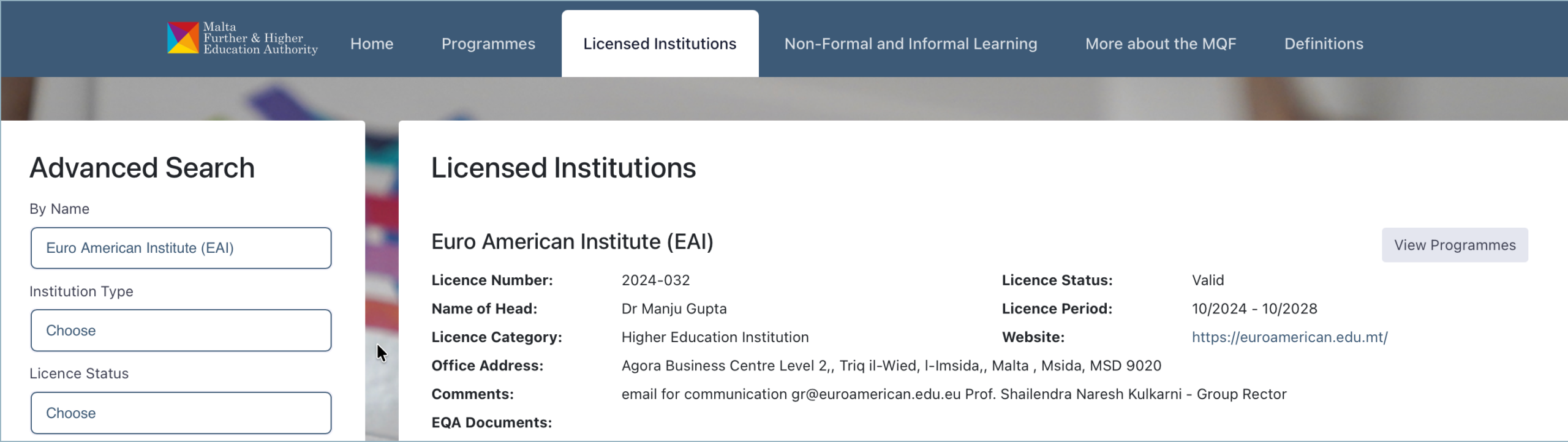
The European master’s qualification within the SwissEU™ pathway is awarded by EuroAmerican Institute (EAI), Malta, a higher education institution licensed by the Malta Further and Higher Education Authority (MFHEA).
Under Higher Education Institution Licence No. 2024-032, EAI operates as a Higher Education Institution in Malta. Its approved programmes are positioned within the Malta Qualifications Framework (MQF) and referenced to the European Qualifications Framework (EQF).
MFHEA is Malta’s competent authority for the licensing, accreditation and quality assurance of further and higher education.
This provides the regulatory framework supporting the EAI qualification within the SwissEU™ dual-qualification pathway.
Aligned with Swiss Live Class Direct™
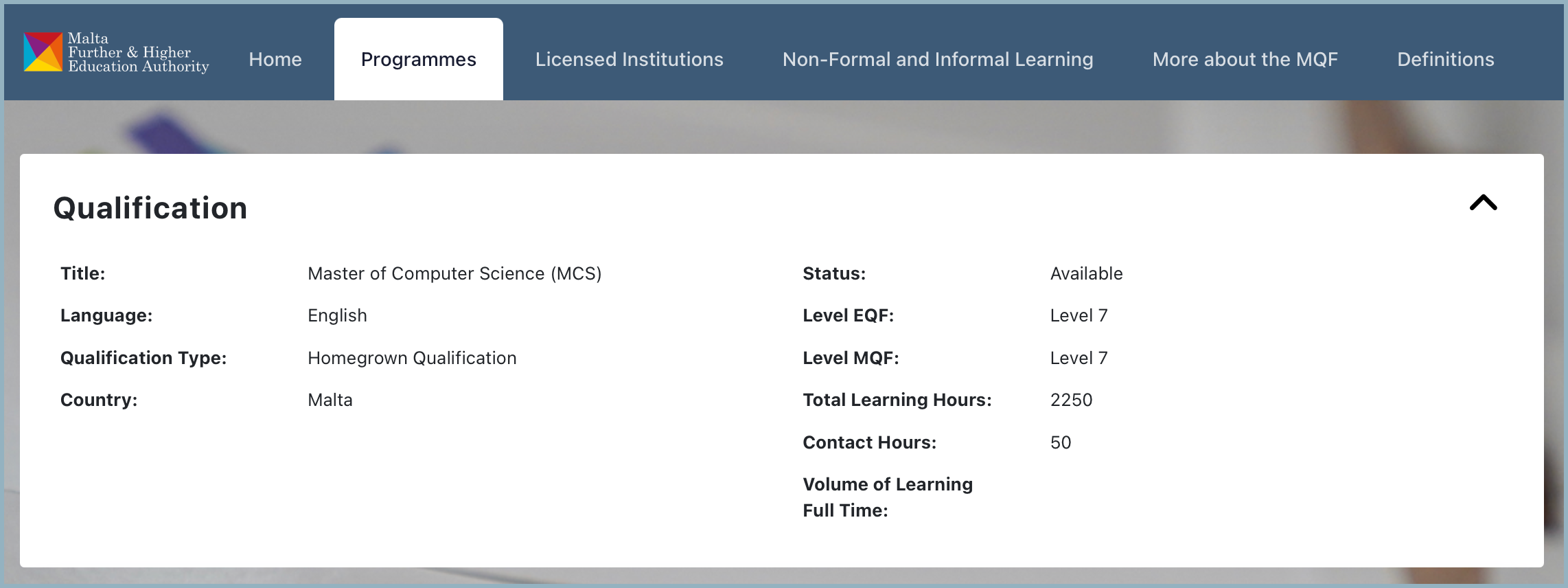
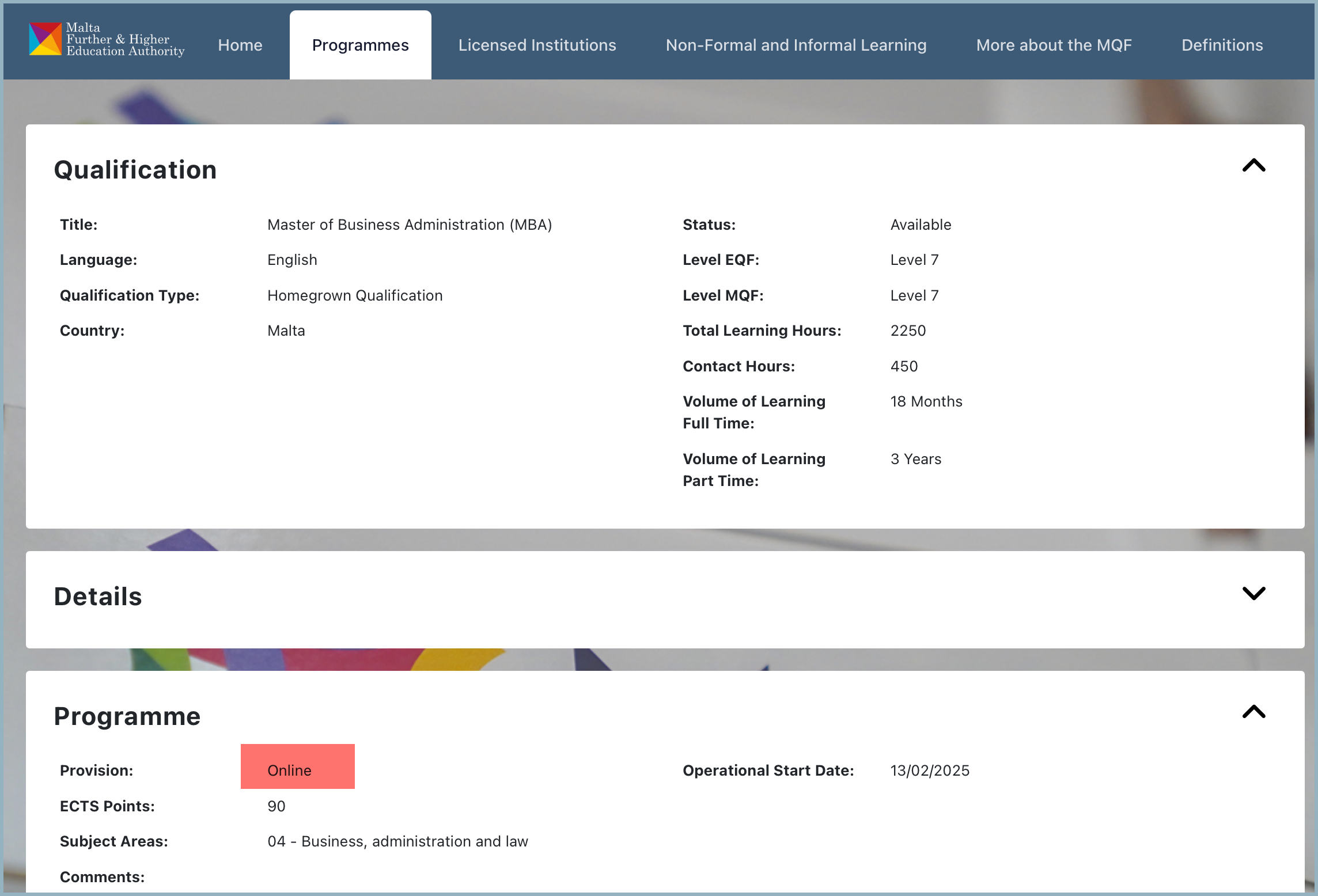
The online delivery mode of the applicable EAI programme operates within the relevant MFHEA regulatory framework in Malta.
This complements the Swiss Live Class Direct™ model, through which learners receive structured academic engagement, research development and research support.
Together, these elements provide a structured online master’s research experience combining Swiss academic engagement with the applicable European qualification framework.
Verify MFHEA Online Delivery Approval — VIEW HERE
EAI qualifications are positioned within the Malta Qualifications Framework (MQF), which is referenced to the European Qualifications Framework (EQF). This supports transparency and comparability across national qualification systems.
Malta is part of the European Higher Education Area (EHEA) and participates in the Bologna Process, connecting its higher education framework with the wider European higher education architecture.
International qualification recognition information in Malta is supported through MQRIC, the country’s official ENIC-NARIC centre within MFHEA.
Recognition remains subject to the requirements and procedures of the relevant receiving institution or competent authority.
Explore the ENIC-NARIC Network — VIEW HERE
The Swiss qualification within the SwissEU™ dual-qualification pathway is awarded by the European Institute of Management and Technology (EIMT), Switzerland, a private education institution established in the Canton of Zug.
EIMT combines a Swiss academic identity with an international quality-assurance profile focused on applied education, business, management and professional development.
Its institutional quality framework includes ACBSP accreditation candidacy, private external quality assurance, quality certification and international professional memberships.
EIMT has been granted candidacy status in the accreditation process of the Accreditation Council for Business Schools and Programs (ACBSP), an international organisation specialising in the accreditation of business and business-related education programmes.
ACBSP candidacy represents a formal developmental stage in the accreditation process, involving institutional review, quality improvement and progression toward the applicable ACBSP standards.
Candidate status is not the same as accreditation. EIMT or its programmes should be described as ACBSP-accredited only if and when formal accreditation is subsequently granted by ACBSP.
For SwissEU™ learners, this adds an international business-education quality dimension to the Swiss component of the dual-qualification pathway.
In addition to its ACBSP candidacy, EIMT maintains a range of international quality credentials and professional affiliations supporting institutional development, digital learning and applied higher education.
These currently include:
- QAHE — Private, non-governmental institutional accreditation
- AQS / ISO/IEC 40180:2017 — Quality certification for technology-enhanced learning
- EURASHE — Institutional membership
- USDLA — Professional membership
- ATHEA — Institutional membership
These credentials represent different forms of external quality assurance, certification and professional engagement. They should not be interpreted as Swiss governmental accreditation or as automatically conferring recognition of EIMT qualifications by third parties.
Information relating to accreditation, recognition, qualification frameworks, memberships and quality assurance is provided for information and transparency purposes only.
Recognition, equivalency, professional use, further study, employment, professional registration, immigration-related use or acceptance of any qualification is not automatic and may vary according to the country, receiving institution, employer, professional body or competent authority.
SwissEU™, SIMI Swiss, EIMT and EAI do not guarantee any specific recognition, acceptance, equivalency or third-party outcome. Learners should verify the requirements applicable to their intended use of the qualification with the relevant receiving organisation or authority.
Frequently Asked Questions
- Understanding Your Dual Qualification
- Using Your Qualifications with Confidence
Upon successful completion of all academic and graduation requirements, learners receive two master’s-level qualifications:
- Master of Business Administration from EAI Malta
- Master of Business Administration from EIMT Switzerland
A taught MBA normally follows a structured curriculum covering a predetermined range of management and business subjects.
The MBA – By Research places greater emphasis on independent investigation. Learners develop an approved business or management research topic and progress through research design, methodology, supervised research and dissertation development.
Both models operate at master’s level, but their learning journeys and academic emphasis are different.
Applicants do not necessarily need to have a fully developed research proposal at the initial enquiry stage.
However, having a preliminary research interest, organisational problem, professional challenge or intended area of management research can support academic assessment and research pathway planning.
The final research topic remains subject to academic review and approval.
No.
The programme is structured around an individual research direction rather than a predetermined specialisation.
Learners may conduct research in areas such as strategic management, leadership, finance, marketing, human resources, entrepreneurship, digital transformation or other approved fields of business and management.
The research area should not be confused with a separate specialisation award.
The approved dissertation topic defines the academic focus of the learner’s research.
Yes.
Learners undertaking the research pathway receive academic supervision appropriate to their approved research direction and stage of research.
Supervision is intended to guide research development, methodology, analysis, academic progress and dissertation preparation while maintaining the learner’s responsibility for independent research.
The pathway is primarily research-oriented.
Research development activities may be included to strengthen methodology, analytical capability, academic writing and research skills, but the central focus of the programme is the learner’s independent business and management research and dissertation.
Yes, provided the proposed topic is academically appropriate for business or management research and is approved through the applicable academic process.
Research may address a real organisational challenge involving strategy, leadership, finance, marketing, human resources, operations, digital transformation, entrepreneurship or another relevant area of management.
This allows professional experience to become a potential starting point for academically structured investigation.
The research pathway can provide useful preparation for future doctoral study because learners develop experience in research design, literature review, methodology, data analysis, critical evaluation and dissertation writing.
Research completed at master’s level may also help a learner identify or refine a future doctoral research direction.
Admission to a DBA, Ph.D. or other doctoral programme is not automatic and remains subject to the requirements and academic assessment of the receiving institution.
The programme is delivered online through Swiss Live Class Direct™, combining structured research development, academic engagement, supervision and integrated learner support.
The qualification may be presented for further study, professional development, employment or other legitimate academic and professional purposes.
Final acceptance remains subject to the policies and requirements of the relevant university, employer, professional body or competent authority.
Book a 1:1 consultation
Discuss your academic background, professional experience and intended research direction with the SwissEU™ support team. Our team can help you understand the research pathway, admission requirements, dual qualifications, research development process and the next steps applicable to your profile.
SwissEU™
SwissEU™ is the online higher education platform bringing together Swiss-made education and nationally recognised European qualifications.
SWISS MADE. EUROPEAN RECOGNISED.
© 2026 SwissEU™ • Powered by Swiss Information and Management Institute (SIMI Swiss)