
SwissEU™ Dual Qualification
MASTER OF EDUCATION
The SwissEU™ Master of Education (M.Ed) is designed for educators, academic leaders and education professionals seeking to strengthen their expertise in teaching, learning, educational leadership and innovation.
The programme combines advanced education studies, applied professional learning and research, with the opportunity to develop an approved specialisation aligned with the learner’s professional field and academic interests.
Upon successful completion, learners receive two master’s-level qualifications:
- Master of Education from EAI Malta
- Master of Education with an Approved Specialisation from EIMT Switzerland
Delivered through Swiss Live Class Direct™, the programme brings together direct Swiss academic engagement, a nationally recognised European master’s qualification and a Swiss master’s qualification featuring an approved specialisation.

DUAL QUALIFICATIONS
- Master of Education awarded by EuroAmerican Institute, Malta
- Swiss master’s qualification awarded by EIMT, Switzerland

EUROPEAN RECOGNITION
- EuroAmerican Institute is recognised by Malta’s national higher education authority, MFHEA
- The Master of Education is positioned within the applicable MQF/EQF Level 7 framework

Swiss Specialisation
- Swiss qualification from EIMT with an approved education specialisation
- Designed to strengthen a focused academic and professional profile

ONLINE LEARNING
- Swiss Live Class Direct™
- Integrated academic and learner support
- Designed for working education professionals

1. TWO QUALIFICATIONS. ONE PATHWAY.
SwissEU™ combines two complementary master’s qualifications within one integrated academic pathway — bringing together a Swiss qualification from EIMT and a European qualification from EAI Malta.

2. SWISS SPECIALISATION ADVANTAGE
The EIMT qualification provides the Swiss academic dimension and an approved specialisation, helping graduates demonstrate a more focused professional and academic profile in education.

3. EUROPEAN NATIONAL RECOGNITION
The EAI qualification adds the strength of a nationally recognised European awarding institution in Malta, providing an additional layer of formal academic recognition within the dual-qualification pathway.
Programme Details
- Master of Education from EAI Malta
- Master of Education with Specialisation from EIMT Switzerland
Learning & Classroom Environment
Objective: To help learners understand theories of learning, motivation, and learner engagement, and apply them to creating positive, effective classroom environments that support learner development.
Modules:
- MED701 – Creating Positive Classroom Environments
Creating Positive Classroom Environments - MED704 – Theories of Learning and Their Pedagogical Applications
Theories of Learning and Their Pedagogical Applications
Teaching & Pedagogy
Objective: To develop the ability to design and deliver teaching activities, promote learner engagement, apply differentiated instruction, manage classrooms, and implement modern pedagogical approaches appropriate to different educational levels.
Modules:
- MED707 – Advanced Teaching Methods for Secondary Education
Advanced Teaching Methods for Secondary Education - MED708 – Effective Pedagogical Strategies for Elementary and Middle School Grades
Effective Pedagogical Strategies for Elementary and Middle School Grades
Curriculum & Assessment
Objective: To develop the ability to design curricula, undertake pedagogical planning, and establish assessment systems aligned with learning outcomes, learner needs, and educational quality improvement requirements.
Modules:
- MED703 – Strategic Curriculum Development and Pedagogical Planning
Strategic Curriculum Development and Pedagogical Planning - MED709 – Principles and Practices of Student Assessment
Principles and Practices of Student Assessment
Education in Context
Objective: To provide a foundation for analysing education in historical, philosophical, social, and cultural contexts, while developing the ability to examine educational issues from global, diverse, and intercultural perspectives.
Modules:
- MED702 – Foundations of Education: Historical, Philosophical, and Social Perspectives
Foundations of Education: Historical, Philosophical, and Social Perspectives - MED714 – Global Perspectives in Education and Cultural Competence
Global Perspectives in Education and Cultural Competence
Developmental Psychology
Objective: To provide knowledge of learners’ cognitive, social, and emotional development across different stages, from early childhood to adolescence and emerging adulthood, as a foundation for designing appropriate educational support.
Modules:
- MED710 – Developmental Psychology: Early Childhood
Developmental Psychology: Early Childhood - MED711 – Developmental Psychology: Adolescence and Emerging Adulthood
Developmental Psychology: Adolescence and Emerging Adulthood
Inclusive Education
Objective: To develop the ability to identify barriers to learning and student achievement, while designing inclusive educational approaches that respond to diversity in ability, culture, and learning needs.
Modules:
- MED705 – Identifying and Overcoming Obstacles to Student Achievement
Identifying and Overcoming Obstacles to Student Achievement - MED706 – Inclusive Pedagogies for Multicultural and Varied Learning Needs
Inclusive Pedagogies for Multicultural and Varied Learning Needs
STEM Pedagogy
Objective: To develop the ability to design and implement interdisciplinary STEM education through inquiry, project-based learning, and problem-solving, integrating technology, innovation, and practical application appropriate to different educational levels.
Modules:
- MED712 – Innovative STEM Pedagogy for Elementary and Middle School Education
Innovative STEM Pedagogy for Elementary and Middle School Education - MED713 – Innovative STEM Pedagogy for Secondary Education
Innovative STEM Pedagogy for Secondary Education
Educational Research
Objective: To develop the ability to conduct independent research in education, from identifying research problems, reviewing literature, designing research methods, and addressing research ethics to data analysis, academic writing, and completion of a research project.
Modules:
- MED715 – Research Design and Professional Inquiry in Education
Research Design and Professional Inquiry in Education - MED716 – Educational Research Project (Dissertation)
Educational Research Project (Dissertation)
Upon successful completion of all academic and graduation requirements, learners receive two master’s-level qualifications:
- Master of Education — EuroAmerican Institute (EAI), Malta
- Master of Education with an Approved Specialisation — EIMT, Switzerland
Together, they form the SwissEU™ dual-qualification pathway, combining a nationally recognised European master’s qualification with a Swiss master’s qualification featuring an approved specialisation.
Learners may pursue an approved specialisation aligned with their professional role, academic interests and intended area of educational practice.
The final specialisation is subject to academic review and approval and may be refined to reflect the learner’s completed studies and applied research.
Learners may also complete the programme without a specified specialisation and receive a general Master of Education qualification, subject to applicable academic regulations.
Available specialisations may include:
- TESOL®
- Artificial Intelligence (AI) in Education
- Educational Management and Pedagogical Innovation
- Educational Accreditation and Quality Management
- Early Childhood Education
- English-Medium Instruction (EMI)
- Special Educational Needs (SEN)
Typical Route
Applicants should:
- Hold a Bachelor’s degree from an accredited or recognised institution; or
- Hold an equivalent qualification at EQF Level 6 or comparable level.
Applicants from education, teaching, training, academic management or related professional backgrounds may be particularly suited to the programme.
Alternative Route
Applicants who do not meet the standard academic entry requirements may be considered through an applicable APEL/RPL route, subject to academic assessment and approval.
English Language Requirement
- Minimum CEFR Level B2, IELTS 5.5, or equivalent.
Direct academic delivery. Integrated learner support. No franchise teaching.
Learners participate in live online academic sessions directly through Swiss Information and Management Institute (SIMI Swiss) and receive integrated academic and learning support throughout their studies.
Under the SwissEU™ academic model, SIMI Swiss focuses on academic delivery, learning experience and learner support, while the respective qualifications are awarded by EAI Malta and EIMT Switzerland in accordance with their applicable academic regulations.
Swiss Live Class Direct™ enables learners to access the designated academic delivery structure directly, without franchise-based teaching or intermediary academic providers.
This supports programme consistency, direct academic access and a structured online learning experience.
QUALITY ASSURANCE & NATIONAL RECOGNITION
- EIMT Switzerland – International Quality Profile & ACBSP Candidacy
- EAI Malta – Nationally Recognised European Qualification
Swiss academic positioning. European national recognition. One integrated master’s pathway.
- Two master’s qualifications: a Swiss master’s qualification from EIMT Switzerland and a nationally recognised European master’s qualification from EAI Malta.
- Approved specialisation: the EIMT qualification may carry an approved education specialisation.
- European national recognition: the EAI qualification is awarded within Malta’s regulated higher education framework.
- International quality profile: EIMT maintains international quality assurance recognitions and memberships.
- Stronger academic and professional profile: the pathway brings together advanced education, specialisation and two complementary qualification systems.
Recognition, acceptance, professional use or further study is not automatic and remains subject to the requirements of the relevant institution, employer, professional body or competent authority.
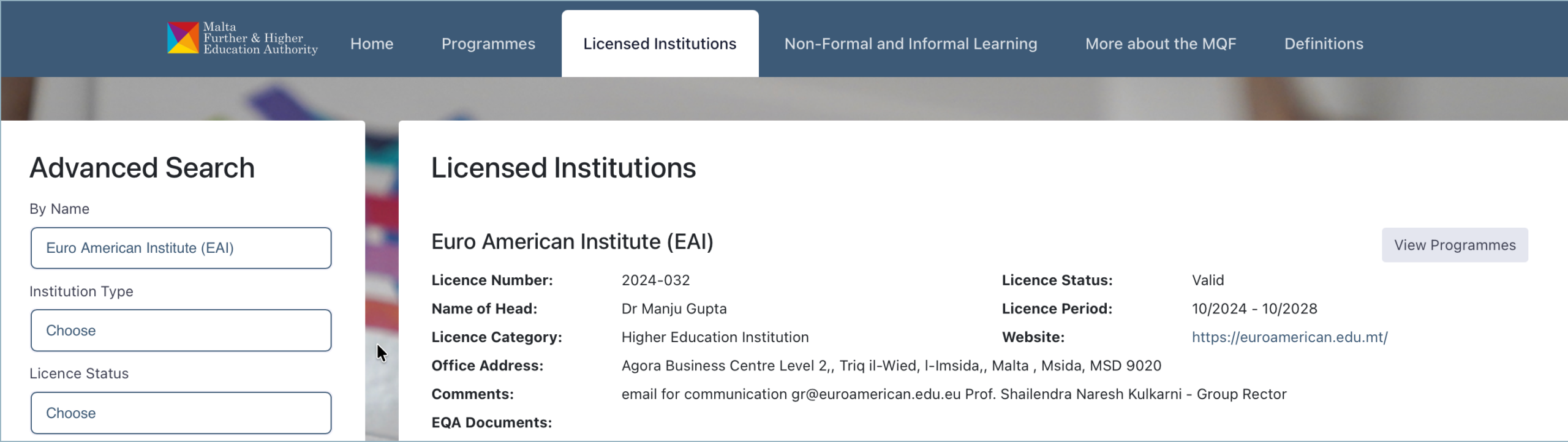
The European doctoral qualification within the SwissEU™ pathway is awarded by EuroAmerican Institute (EAI), Malta, a higher education institution licensed by the Malta Further and Higher Education Authority (MFHEA).
Under Higher Education Institution Licence No. 2024-032, EAI operates as a Higher Education Institution in Malta. Its approved programmes are positioned within the Malta Qualifications Framework (MQF) and referenced to the European Qualifications Framework (EQF).
MFHEA is Malta’s competent authority for the licensing, accreditation and quality assurance of further and higher education. This provides the regulatory framework supporting the EAI qualification within the SwissEU™ dual-qualification pathway.
Aligned with Swiss Live Class Direct™
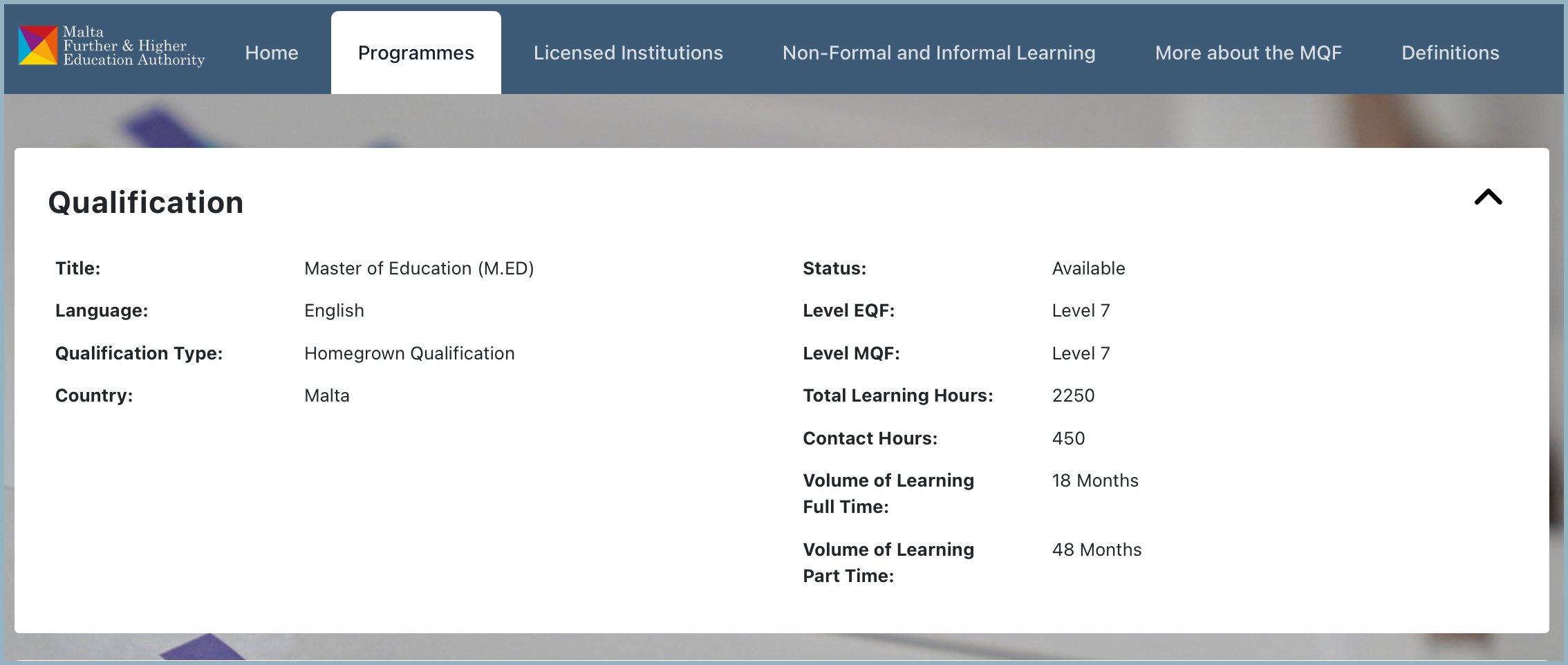
The online delivery mode of the EAI DBA programme is approved within the applicable MFHEA regulatory framework in Malta.
This complements the Swiss Live Class Direct™ model, through which learners attend live online classes directly with SIMI Swiss lecturers and receive integrated academic and research support.
Together, the two elements provide a structured online doctoral experience combining direct Swiss academic deliverywith the approved online delivery framework of the European qualification.
Verify MFHEA Online Delivery Approval — VIEW HERE
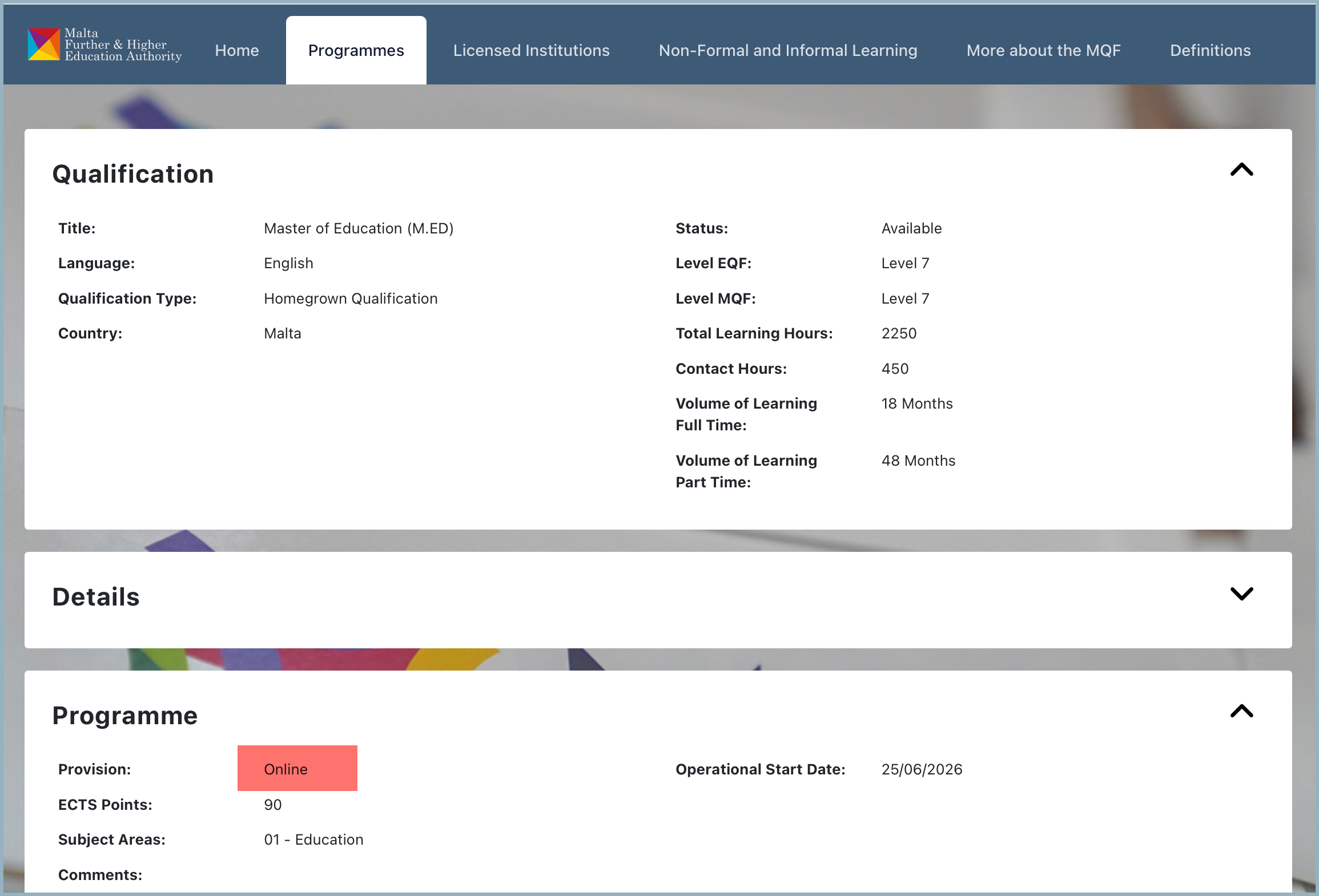
EAI qualifications are positioned within the Malta Qualifications Framework (MQF), which is referenced to the European Qualifications Framework (EQF). This supports transparency and comparability across national qualification systems.
Malta is part of the European Higher Education Area (EHEA) and participates in the Bologna Process, connecting its higher education framework with the wider European higher education architecture.
International qualification recognition information in Malta is supported through MQRIC, the country’s official ENIC-NARIC centre within MFHEA.
Recognition remains subject to the requirements and procedures of the relevant receiving institution or competent authority.
Explore the ENIC-NARIC Network — VIEW HERE
The Swiss qualification within the SwissEU™ dual-qualification pathway is awarded by the European Institute of Management and Technology (EIMT), Switzerland, a private education institution established in the Canton of Zug.
EIMT combines a Swiss academic identity with an international quality-assurance profile focused on applied education, business, management and professional development.
Its institutional quality framework includes ACBSP accreditation candidacy, private external quality assurance, quality certification and international professional memberships.
EIMT has been granted candidacy status in the accreditation process of the Accreditation Council for Business Schools and Programs (ACBSP), an international organisation specialising in the accreditation of business and business-related education programmes.
ACBSP candidacy represents a formal developmental stage in the accreditation process, involving institutional review, quality improvement and progression toward the applicable ACBSP standards.
Candidate status is not the same as accreditation. EIMT or its programmes should be described as ACBSP-accredited only if and when formal accreditation is subsequently granted by ACBSP.
For SwissEU™ learners, this adds an international business-education quality dimension to the Swiss component of the dual-qualification pathway.
In addition to its ACBSP candidacy, EIMT maintains a range of international quality credentials and professional affiliations supporting institutional development, digital learning and applied higher education.
These currently include:
- QAHE — Private, non-governmental institutional accreditation
- AQS / ISO/IEC 40180:2017 — Quality certification for technology-enhanced learning
- EURASHE — Institutional membership
- USDLA — Professional membership
- ATHEA — Institutional membership
These credentials represent different forms of external quality assurance, certification and professional engagement. They should not be interpreted as Swiss governmental accreditation or as automatically conferring recognition of EIMT qualifications by third parties.
Information relating to accreditation, recognition, qualification frameworks, memberships and quality assurance is provided for information and transparency purposes only.
Recognition, equivalency, professional use, further study, employment, professional registration, immigration-related use or acceptance of any qualification is not automatic and may vary according to the country, receiving institution, employer, professional body or competent authority.
SwissEU™, SIMI Swiss, EIMT and EAI do not guarantee any specific recognition, acceptance, equivalency or third-party outcome. Learners should verify the requirements applicable to their intended use of the qualification with the relevant receiving organisation or authority.
Frequently Asked Questions
- Understanding Your Dual Qualification
- Using Your Qualifications with Confidence
Upon successful completion of all academic and graduation requirements, learners receive two master’s-level qualifications:
- Master of Education from EAI Malta
- Master of Education with an Approved Specialisation from EIMT Switzerland
SwissEU™ combines two complementary master’s qualifications within one academic pathway: a Swiss qualification featuring an approved specialisation and a nationally recognised European qualification from Malta.
This is supported through Swiss Live Class Direct™ and integrated academic support.
Yes. Learners may pursue an approved specialisation aligned with their professional field and academic interests, subject to academic review and approval.
The programme is delivered online through Swiss Live Class Direct™, enabling learners to participate in live academic sessions and receive integrated academic and learner support.
The standard completion period depends on the approved programme structure and the learner’s academic progress. Normally, it takes 18 months.
Actual completion time may vary according to study progression, assessment completion and fulfilment of all applicable academic requirements.
The M.Ed may be presented for further study, professional development, employment or other legitimate academic and professional purposes.
Final acceptance remains subject to the policies and requirements of the relevant university, employer, professional body or competent authority.
Book a 1:1 consultation
Discuss your academic background, professional experience, research direction and potential specialisation with the SwissEU™ support team. Our team can help you understand the programme structure, admission pathway, dual qualifications and the next steps applicable to your profile.
SwissEU™
SwissEU™ is the online higher education platform bringing together Swiss-made education and nationally recognised European qualifications.
SWISS MADE. EUROPEAN RECOGNISED.
© 2026 SwissEU™ • Powered by Swiss Information and Management Institute (SIMI Swiss)